
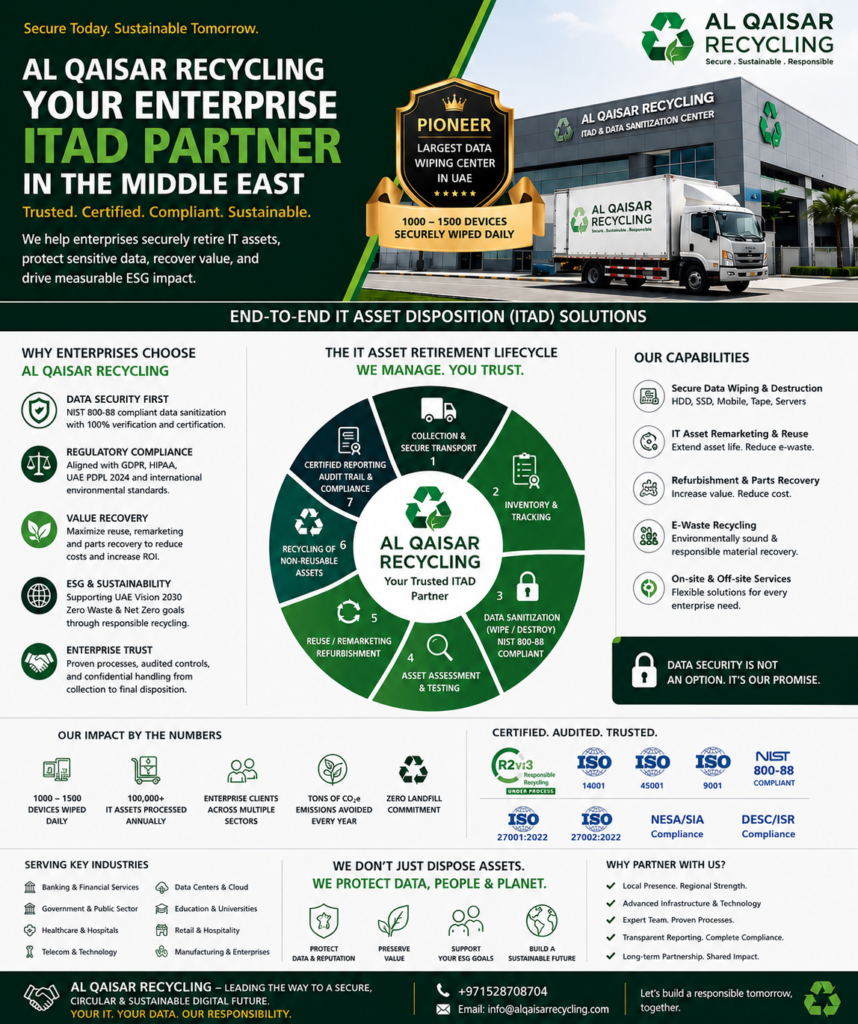
Why Enterprises Need a Purpose-Built RFP for Secure, Responsible & Sustainable IT Asset Disposition (ITAD)
Moving Beyond “IT Disposal” to Enterprise ITAD
Every enterprise eventually faces the same challenge: what happens when laptops, desktops, servers, storage devices, networking equipment, mobile devices and other IT assets reach the end of their useful life?
For many organizations, the traditional answer has been simple: dispose of them or send them for recycling.
But modern enterprises cannot afford to treat retired IT assets as ordinary waste.
A retired laptop may contain confidential customer information. A server may contain business-critical data. A storage drive may contain personal, financial, medical or commercially sensitive information. At the same time, the physical asset may still have significant residual value and contain materials that can be recovered through responsible recycling.
This is why enterprises need to move from IT disposal to professional IT Asset Disposition (ITAD).
And more importantly, enterprises need a purpose-built ITAD RFP that evaluates security, compliance, asset value recovery, environmental responsibility, traceability and sustainability—not simply the lowest recycling price.
What Is Enterprise ITAD?
IT Asset Disposition (ITAD) is the controlled process of managing IT assets when they are retired, replaced, returned, excess, obsolete or no longer required.

Collection → Secure Transport → Inventory → Data Sanitization → Verification → Asset Assessment → Reuse/Refurbishment → Remarketing → Parts Recovery → Responsible Recycling → Certified Reporting
The objective is not simply to make an asset disappear.
The objective is to:
* Protect the data
* Protect the enterprise
* Recover maximum asset value
* Reduce environmental impact
* Maintain complete chain of custody
* Demonstrate regulatory and ESG compliance
* Create an auditable record of every asset
This makes ITAD a strategic enterprise service—not merely a waste-management activity.
Why an Enterprise ITAD RFP Is Necessary
A generic recycling RFP may ask:
“Who can collect and recycle our electronic waste at the best price?”
A professional ITAD RFP should ask a much more important question:
“Who can securely, responsibly and sustainably manage the complete retirement journey of our IT assets while protecting our data, maximizing value and providing auditable evidence of final disposition?”
That difference is critical.
An enterprise may have thousands—or even hundreds of thousands—of retired IT assets moving through its organization every year. Without a structured RFP, important questions can remain unanswered:
* Who has physical custody of the assets?
* How is chain of custody maintained?
* How is data-bearing equipment identified?
* What happens to HDDs and SSDs?
* What data sanitization methodology is used?
* Is wiping verified?
* What happens when wiping is unsuccessful?
* Which assets are reusable?
* Who determines residual value?
* Where are assets remarketed?
* Who handles non-reusable equipment?
* Are downstream recyclers controlled?
* Can every asset be individually traced?
* What certificates and reports are provided?
* How are ESG outcomes measured?
* What happens to assets that cannot be securely sanitized?
A properly designed ITAD RFP turns these questions into contractual requirements and measurable performance obligations.
The Five Pillars of a Secure & Sustainable Enterprise ITAD RFP
1. Data Security & Privacy
Data security must be the first pillar of enterprise ITAD.
Before any retired IT asset leaves an organization’s control, the enterprise should have confidence that sensitive information will be securely managed.
An ITAD RFP should define requirements for:
* Secure collection and transportation
* Chain-of-custody controls
* Asset identification and serial-number tracking
* Data-bearing device identification
* Secure data sanitization
* Verification of sanitization
* Individual data sanitization certificates
* Handling of failed or damaged drives
* Physical destruction where sanitization is not appropriate
* Secure handling of mobile devices, HDDs, SSDs, servers and other storage media
* Audit trails and reporting
The principle should be simple:
No data-bearing asset should leave the ITAD process without a clearly documented and verifiable data-security outcome.
2. Responsible Asset Disposition
Not every retired IT asset is waste.
A laptop may still have years of useful life. A server may be suitable for secondary markets. Components may have recoverable value.
Therefore, enterprises should prioritize the hierarchy:
Reuse → Refurbishment → Remarketing → Parts Recovery → Recycling → Destruction
Physical destruction should not automatically be the first option.
A responsible ITAD provider should evaluate each asset and determine the most appropriate disposition route based on:
* Condition
* Age
* Market value
* Data-security requirements
* Reparability
* Reuse potential
* Regulatory requirements
* Environmental considerations
This approach supports the circular economy while helping enterprises recover value from retired technology.
3. Complete Chain of Custody & Traceability
Enterprise ITAD should operate on the principle:
“If we cannot trace it, we cannot fully trust it.”
The RFP should require asset-level visibility from collection through final disposition.
A robust system should be capable of documenting:
Asset ID → Serial Number → Collection Location → Transport → Receiving → Data Sanitization → Testing → Disposition Decision → Remarketing/Recycling → Final Outcome
This creates an auditable digital trail.
For enterprise customers, this can significantly improve internal governance and simplify audits.
4. Environmental Responsibility & Circular Economy
Sustainable ITAD is more than sending electronics to a recycling facility.
A responsible program should maximize the useful life of technology before material recycling becomes necessary.
Enterprises should therefore evaluate providers based on their ability to:
* Extend asset life
* Enable reuse and refurbishment
* Recover components
* Reduce unnecessary destruction
* Recover valuable materials
* Minimize landfill
* Control downstream recycling
* Provide environmental reporting
* Measure sustainability outcomes
The goal is to transform:
“End-of-life IT”
into
“End-of-first-life IT.”
An asset reaching the end of its first enterprise deployment does not necessarily mean it has reached the end of its useful life.
5. Certified Reporting & ESG Evidence
A modern enterprise needs evidence—not simply assurances.
An ITAD RFP should require reporting that demonstrates what happened to the organization’s assets.
Depending on the service scope, reporting can include:
* Asset inventory reports
* Data sanitization certificates
* Destruction certificates
* IT asset disposition certificates
* Chain-of-custody records
* Remarketing reports
* Recycling certificates
* Material recovery information
* Environmental impact metrics
* ESG reporting
* Downstream partner information
* Audit documentation
This allows ITAD to become part of the organization’s wider ESG, information-security and sustainability reporting framework.
The RFP Should Measure the ITAD Partner—Not Just the Price
One of the biggest mistakes enterprises can make is evaluating ITAD providers primarily on collection or recycling price.
The lowest price does not necessarily represent the lowest total cost or lowest risk.
A professional RFP should evaluate providers across multiple dimensions:
Evaluation Area. What Enterprises Should Assess
Data Security Sanitization methodology, verification, destruction controls
Compliance Applicable environmental, privacy and industry requirements
Chain of Custody. Asset tracking and custody controls
Asset Recovery. Reuse, refurbishment and remarketing capability
Recycling Responsible processing and downstream controls
Technology Inventory, tracking and reporting systems
Certifications Relevant industry and management-system certifications
ESG Environmental impact and circular-economy outcomes
Reporting Asset-level certificates and management reports
Geographic Coverage On-site, off-site and regional capabilities
Business Continuity Capacity, logistics and operational resilience
Commercial Model Transparent pricing and value recovery
Auditability Ability to demonstrate what happened to every asset
A Purpose-Built Enterprise ITAD RFP Should Include These Sections
Enterprises considering an ITAD partner should structure their RFP around at least the following:
Section 1 — Company & Capability
* Company profile
* ITAD experience
* Facility information
* Processing capacity
* Geographic coverage
* Key personnel
Enterprise references

Section 2 — Information Security
* Data sanitization methodology
* Verification procedures
* Chain-of-custody controls
* Storage-media handling
* Physical destruction procedures
* Security controls
Section 3 — Asset Management
* Asset tagging
* Serial-number capture
* Inventory reconciliation
* Tracking platform
* Reporting
Section 4 — Value Recovery
* Testing and grading
* Refurbishment
* Remarketing
* Parts recovery
* Revenue-sharing model
Section 5 — Environmental Management
* Reuse hierarchy
* Recycling processes
* Downstream management
* Zero/low-landfill objectives
Environmental reporting

Section 6 — Compliance & Certifications
* Environmental compliance
* Data-security standards
* Relevant ITAD certifications
* Management-system certifications
* Regulatory compliance
Section 7 — Service Delivery
* Collection
* Secure transportation
* On-site services
* Off-site processing
* Regional logistics
* Emergency/priority services
Section 8 — Reporting & Audit
* Certificates
* Monthly/quarterly reporting
* Asset reconciliation
* ESG metrics
* Audit rights
* Downstream transparency
Section 9 — Commercial Proposal
* Collection charges
* Processing charges
* Destruction charges
* Recycling charges
* Revenue recovery
* Revenue-sharing
* Transportation
* Additional services
Section 10 — KPIs & SLA
The contract should establish measurable KPIs for:
Security | Traceability | Processing Time | Data Sanitization | Asset Recovery | Recycling | Reporting | Compliance | Customer Service
Why Al Qaisar Recycling Can Position Itself Differently
For the Middle East market, Al Qaisar Recycling should position itself beyond the traditional image of an e-waste recycler.
The stronger proposition is:
Enterprise ITAD Partner — Secure the Data. Recover the Value. Protect the Planet.
Al Qaisar can bring together the three areas that enterprises increasingly need from a single strategic partner:
🔐 DATA SECURITY
Secure data sanitization, verification, documentation and controlled destruction for assets that cannot be safely sanitized.
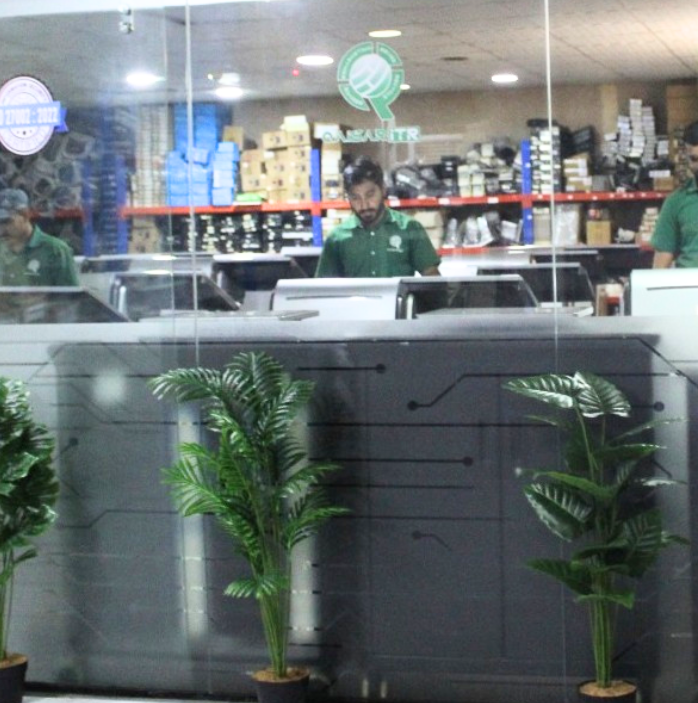
♻ ASSET VALUE RECOVERY
Assessment, refurbishment, reuse, remarketing and parts recovery to maximize the economic life of technology.
🌱 CIRCULAR & RESPONSIBLE RECYCLING
Responsible processing of non-reusable IT assets with a focus on material recovery, environmental protection and measurable sustainability outcomes.
This creates a proposition that is significantly stronger than:
“We collect and recycle your e-waste.”
Instead:
“We securely manage your retired IT assets from enterprise collection to verified data sanitization, value recovery and responsible final disposition.”
The Middle East Opportunity
As organizations across the UAE and wider Middle East accelerate digital transformation, cloud adoption, cybersecurity programs and technology refresh cycles, the volume and complexity of retired IT assets will continue to grow.
Enterprises in banking, financial services, government, healthcare, telecom, data centers, education, hospitality, retail and manufacturing increasingly need a professional answer to one fundamental question:
What happens to our technology after we stop using it?
The answer should not be simply “recycled.”
The answer should be:
Securely collected.
Individually tracked.
Data securely sanitized.
Assets professionally assessed.
Maximum value recovered.
Reusable technology returned to the circular economy.
Non-reusable equipment responsibly recycled.
Every outcome documented and auditable.
From RFP to Long-Term Strategic Partnership
A well-designed RFP is not merely a procurement document.
It is the foundation of an enterprise’s IT Asset Disposition governance framework.
It defines expectations before the first asset is collected. It establishes measurable standards. It protects the enterprise from unmanaged downstream risk. It creates transparency around data security and asset value. And it converts sustainability objectives into measurable operational outcomes.
For this reason, enterprises should stop asking:
“Who can recycle our old IT equipment?”
and start asking:
“Who can become our trusted Enterprise ITAD Partner?”
Al Qaisar Recycling: Your Enterprise ITAD Partner in the Middle East
Al Qaisar Recycling aims to help enterprises build a secure, responsible and sustainable retirement pathway for their IT assets—combining data sanitization, asset recovery, reuse, refurbishment, remarketing, responsible disposition and e-waste recycling within an integrated ITAD model.
The future of IT asset retirement is not about disposing of technology faster.
It is about managing technology more securely, more intelligently and more sustainably.
Secure the Data.
Recover the Value.
Extend the Life.
Recycle Responsibly.
Prove the Outcome.
Al Qaisar Recycling — Enterprise ITAD for a Secure, Circular & Sustainable Digital Future.